
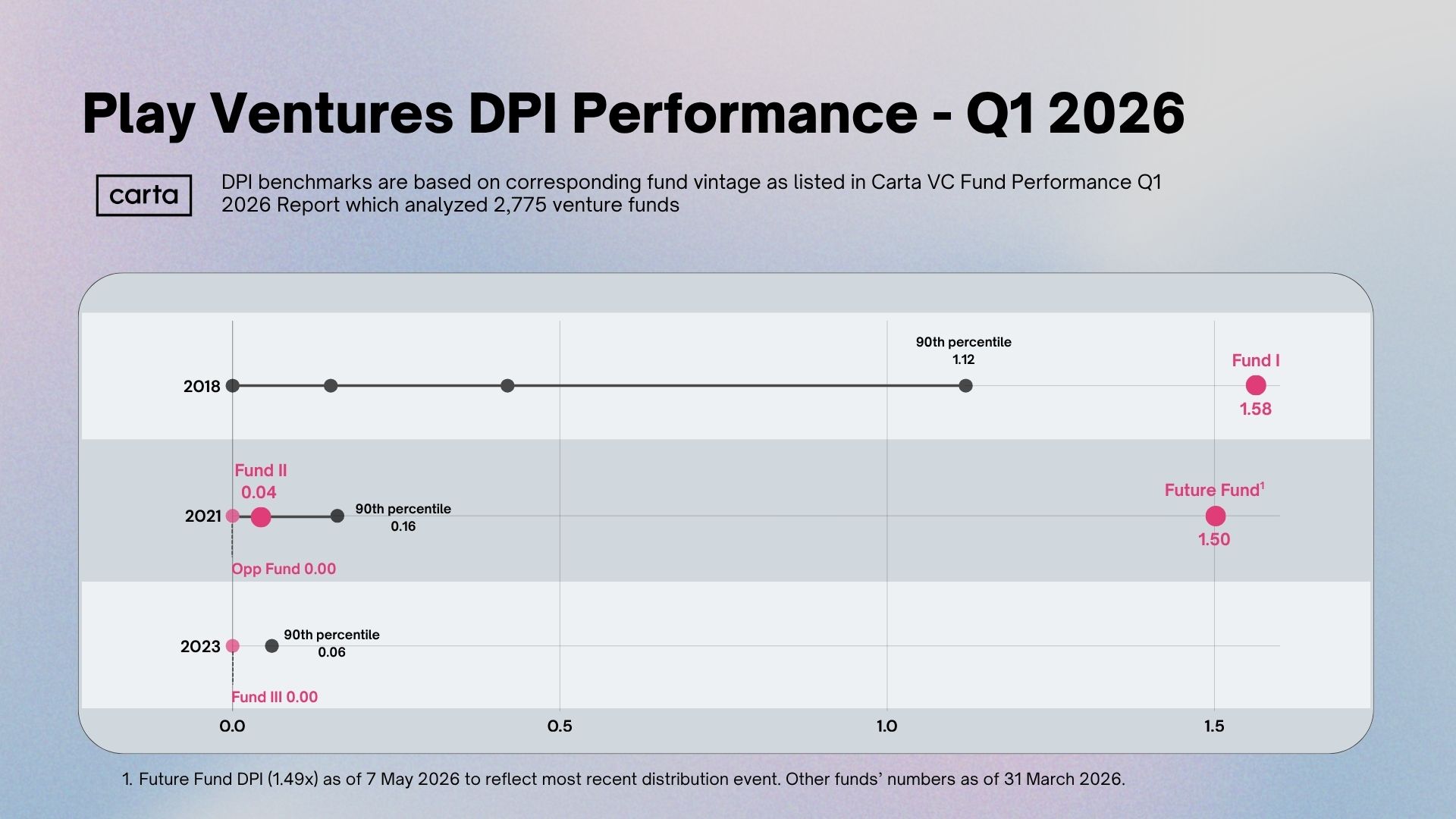
Most 2021-vintage venture funds have returned little or no cash to investors. In Carta's Q1 2026 VC Fund Performance Report, the 90th percentile for 2021-vintage DPI sits at just 0.16x, and the median is near zero. Play Ventures' Future Fund, a 2021 vintage, defies this trend and in Q2 2026, we paid out $37m USD to Future Fund investors, taking the DPI to 1.5x. LPs have their full invested capital back and roughly half again on top, more than nine times the top-decile bar for its vintage. Across our five funds, returns rank top-decile or top-quartile against vintage- and fund-size-matched peers in Carta's Q1 2026 report (2,775 funds benchmarked), as of Q1 2026 (Future Fund DPI as of 7 May 2026).
These figures mark current progress, not the final tally. All of our funds are still within their defined lifetime, with many of the strongest companies still active and compounding, and much of their value, we believe, still ahead.
Two metrics matter most. Net IRR is the annualized return our LPs actually earn after all fund-level costs, management fees and carried interest, are deducted. DPI is its realized counterpart: the cash we have so far returned to LPs as a multiple of what they paid in.
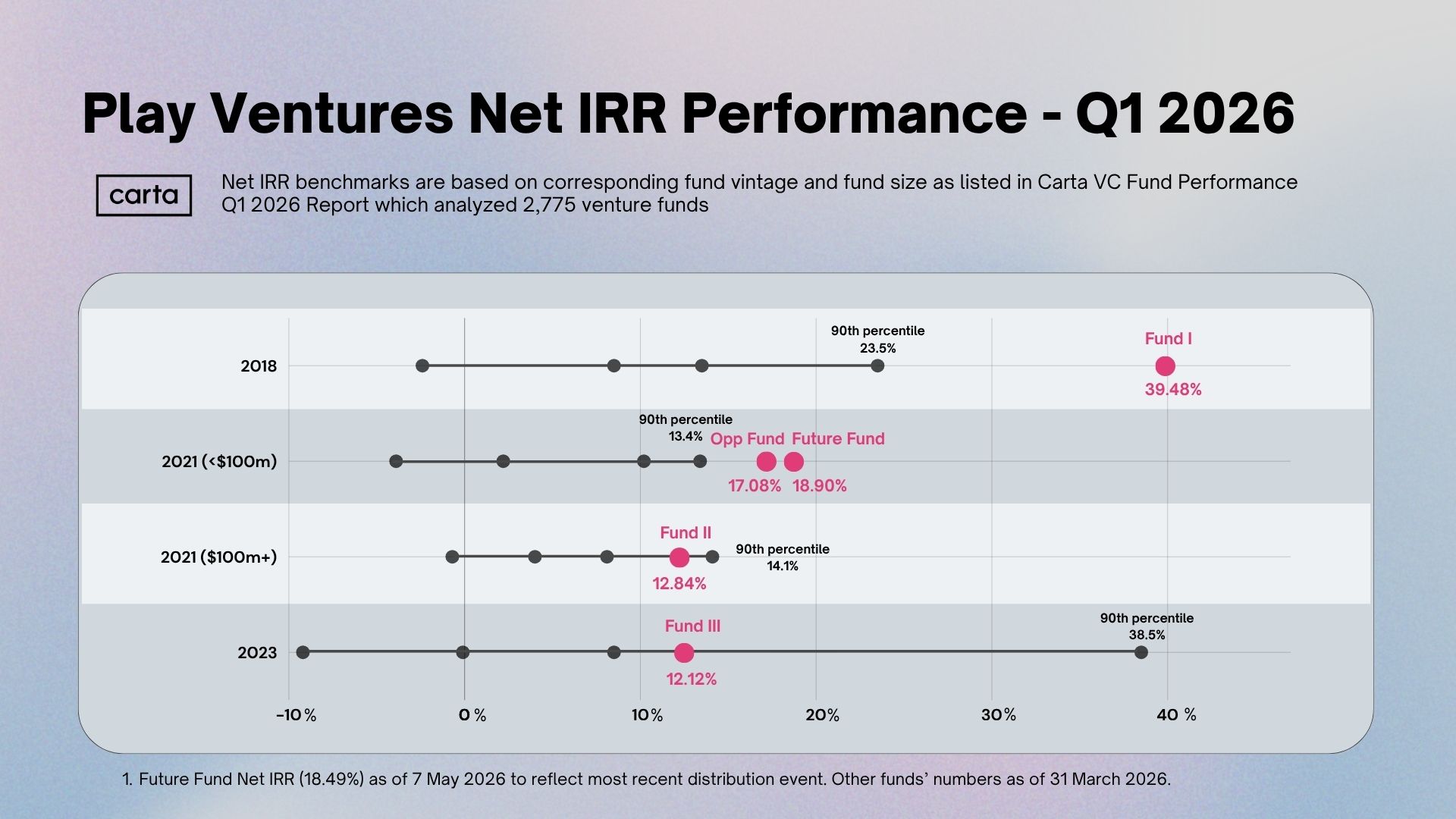
Net IRR benchmarks are matched on vintage and fund size; DPI benchmarks are matched on vintage. Source: Carta VC Fund Performance Report, Q1 2026 (2,775 funds). Figures as of Q1 2026; Future Fund as of 7 May 2026.
DPI, the cash actually returned to LPs as a multiple of capital paid in, is vintage-dependent: realization usually takes the better part of a decade, so a 2021 fund returning capital this early is rare by definition. Institutional LPs increasingly treat DPI as the most reliable measure of real performance, because unlike paper valuations it cannot be inflated.
For a 2021 vintage in this market, Future Fund's 1.5x DPI sits far above the top decile. The vintage's 90th-percentile DPI in Carta's data is 0.16x; Future Fund has returned more than nine times that, having paid LPs back their full invested capital and roughly half again on top. That is something the vast majority of 2021 funds have not come close to.
A venture fund exists to return capital, and everything else follows. In our work we value candor and transparency, and it shows first in how we work with founders: good news or bad, we strive to be accessible and always a simple WhatsApp message away.
That candor does not stop with our founders; it extends to our investors and the wider market. Venture is an opaque industry, and we would rather help change that than hide behind it. In that spirit, we want to disclose an updated performance benchmark of all of our funds, something we have done before.
Play Ventures Fund I has generated a 39.5% net IRR and 1.58x DPI, ranking top-decile among 2018-vintage funds in Carta's Q1 2026 benchmark (90th percentile: 23.5% net IRR, 1.12x DPI).
Our debut fund was built predominantly on gaming content, but even then we were backing the game-related tech that would come to define the category: early, conviction bets on companies like Dataseat in mobile ad tech and mod.io in cross-platform modding. The fund's exits span both sides of that thesis: Reworks (acquired by Playtika) and Savage Game Studios (by PlayStation) on the content side, Dataseat (by Verve Group) on the tech side. Over 50% of the fund's original portfolio is still active and compounding, including category leaders such as Funcraft, M-League, and Bigger Games in mobile gaming, mod.io in user-generated content, and Gamefam in Roblox publishing.
Play Ventures' Future Fund has returned 1.5x DPI and an 18.9% net IRR, both top-decile for the 2021 vintage. The fund has already returned LPs more than their full invested capital, against a vintage 90th-percentile DPI of 0.16x.
Future Fund is focused on token-based gaming and infrastructure, which makes the headline number stand out further. As the benchmarks show, that is rare for any 2021-vintage fund, and in this category nearly unheard of.
Play Ventures' Opportunity Fund has generated a 17.1% net IRR, ranking top-decile among 2021-vintage funds in Carta's Q1 2026 benchmark.
Opportunity Fund follows on into our highest-conviction winners and makes selective initial investments at a later stage. Concentrating capital behind proven performers like EloElo (India's number-one microdrama platform and a top-three downloaded app globally) and Midnite (a hypergrowth sportsbook and casino operator) has carried its net IRR to 17.1% and into top-decile performance in its vintage.
Play Ventures' Fund II has generated a 12.8% net IRR, ranking top-quartile among 2021-vintage funds in Carta's Q1 2026 benchmark.
Fund II was anchored in gaming content while also backing key technologies that increasingly define the industry. That breadth shows in its exits: Loupedeck in creative hardware and software (to Logitech), Alter.xyz in AI (to Google), and INCRMNTAL in marketing technology. Its active portfolio includes several category leaders: the DTC and payments platform Appcharge, which recently raised a $58M Series B and crossed $1 billion in processed annualized volume; Scenario, which has become the trusted generative-media platform of gaming's top publishers; and gaming-content studios including Cypher Games (a Series A mobile puzzle studio) and Game Story (a fast-growing real-money gaming platform).
Play Ventures' Fund III has generated a 12.1% net IRR, ranking top-quartile among 2023-vintage funds in Carta's Q1 2026 benchmark.
Fund III spans gaming content, playable apps, and foundational technology behind both. More than the early IRR, we have been encouraged by strong, broad-based business growth across the portfolio, and a strong graduation rate of companies onto the next fundraising stages: see the Series As of the faith-tech company Bible Chat, the couples' wellness platform Arya, the generative-AI research lab BeyondOS, and the user-acquisition growth platform PVX Partners.
The clearest way to read these numbers is against the distribution of the vintages they belong to, rather than against an all-weather average. In Carta's Q1 2026 data, the 2021 vintage has a 90th-percentile DPI of 0.16x and a median near zero. Future Fund's 1.5x DPI sits far above the top of that distribution. On the net IRR side, Fund I's 39.5% clears the 2018 vintage's 90th percentile of 23.5%, and Future Fund's 18.9% clears the 2021 (sub-$100m) 90th percentile of 13.4%. Read this way, the pattern is not a single outperforming fund but a manager sitting at or above the top of its peer distribution across multiple vintages.
The common thread across all five funds is discipline. We keep our funds deliberately small and concentrated rather than scaling AUM, the lean portfolio construction that academic and LP analyses repeatedly link to stronger venture returns per dollar invested. Our edge is deep sector expertise and concentration in a category we know well, which lets us maintain entry-valuation discipline and capitalize on early exits where generalist funds cannot. Few managers post top-decile or top-quartile performance consistently across five funds and four vintages, and that consistency, rather than a single standout fund, is the clearest signal of repeatable returns.
That discipline matters now more than ever. Gaming venture funding has fallen sharply from its 2021 peak (by some industry estimates roughly 90%), and strong returns across the asset class have concentrated among a handful of managers. Against that backdrop, we continue to deploy capital into the best founders in the space. Our aperture on the gaming-related landscape keeps evolving with consumer preferences and technological shifts, but our guiding principle does not. A venture fund exists to return capital, and we intend to keep doing exactly that.
If you are a founder building in gaming-inspired spaces, or an LP who values returns over scale, we are a message away.
The benchmark data comes from Carta, the fund administration and cap-table software provider, whose data spans thousands of private funds and gives it one of the most comprehensive views into how venture funds actually perform. Its Q1 2026 VC Fund Performance Report covers 2,775 funds, and we measure each of ours against peers of the same vintage (and, for net IRR, of similar fund size), so we are judged against funds raised in the same year and facing the same market.
This publication has not been reviewed by the Monetary Authority of Singapore. Past performance of the manager is not necessarily indicative of its future performance.
